Accept the rules
Confirm the window, the tooling policy, evidence collection, and the submission contract.
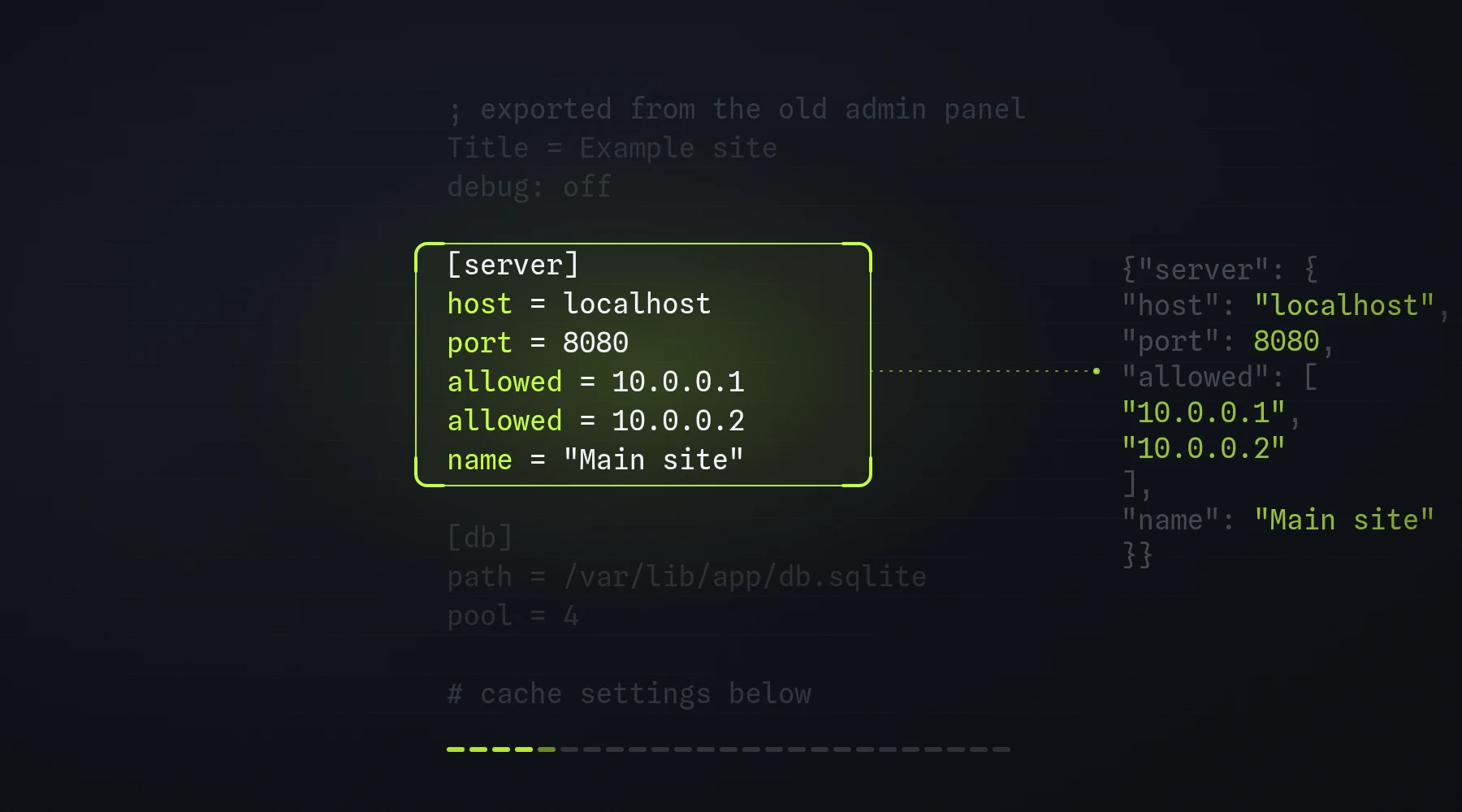
A settings-file tool from 2009 is being retired. Write the parser that replaces it, and make it agree with the tool on every file.
Recurring: enter again after a result to beat your best score. Your best result counts, and your rating moves only on your first attempt.
Ask before you start. The clock cannot be paused once your window opens.
The tool that has read the company's settings files since 2009 runs on one old host and is being retired. Its documentation covers the basics; the files in use rely on behaviour it never mentioned. Write parse so that it returns, for every file, exactly what the tool prints. You can ask the tool what it makes of a file 25 times, 240 bytes at a time.
Diagnosis, validation, and repair are scored. Submission speed is not.
You are given a Node 22 · JavaScript codebase and work inside it. The stack is fixed for this challenge.
Confirm the window, the tooling policy, evidence collection, and the submission contract.
A private repository, seeded with the challenge. You get one clone command and your clock starts.
Use any editor, agent, or model. Declare your tooling; it is recorded on your result.
Confirm at any time that your submission builds, starts, and answers its health check.
Your last push received on main before the deadline is your submission. Submit early if you are done.
Your submission is built and run in an isolated environment: public tests, hidden tests, edge cases, security scans, and two independent code reviews.
What passed, what failed, where points were lost, and how stronger submissions differed.
Automated checks make up most of the score. Two independent code reviews cover what tests cannot, and every review finding cites a file and line.
The “AI workflow and verification” band (15%) requires the Finals companion, which Open Submission does not use. Its weight is spread across the remaining bands. The percentages below are the ones applied.
Build, startup, public and hidden tests, edge cases, performance, dependencies, security, and accessibility where relevant.
Two independent code reviews, each by a different model. Every finding cites a file and line.
Not scored at this tier. Requires the Finals companion session log.
Your submitted commit is graded in an isolated environment, and its push history is confirmed against the challenge window.
Score band, discipline, calibrated difficulty, verification tier, placement, and rating movement.
Score breakdowns, failing tests and their inputs, review findings, how stronger submissions differed, repository contents, and transcripts.
Keystrokes and screen recordings, except during a live round you opt into. Secrets are redacted on your machine before anything is uploaded.